Changing Nutritional Needs throughout Life

Age affects our nutritional needs. Sometimes the differences are obvious. It is easy to see the difference in the amount and types of food an infant, school-age child, teenager, and adult need. Other differences are more subtle. You may not realize that, as you get older, your calorie needs decrease, especially if you become less active. Being aware of such...

Smoking’s Damaging Effects on Your Body

In addition to the addictive drug nicotine, the other principal harmful substances in cigarettes are tar and carbon monoxide. Tar is a sticky, brown residue that collects in the lungs. Primarily made up of chemicals known as hydrocarbons, tar is a powerful cancer-causing agent that has been linked to the development of lung cancer. Carbon monoxide is...

The Dangers of Anabolic Steroids

Professional and amateur athletes sometimes use supplements or drugs to improve their physical performance. Anabolic steroids are probably the most well-known performance-enhancing drugs, and the most dangerous. These synthetic drugs imitate the effects of the male hormone testosterone. The drugs have approved medical uses, but athletes use them to make their muscles bulkier and stronger.

The Different Types of Exercise

There are different types of exercise, and each type has different effects on your body. Some types of exercise improve flexibility and muscle strength. Others use the large muscles in your body to build heart strength. Still others increase endurance. Exercises fall into three categories—aerobic, strength conditioning, and flexibility. Which type is best...

Hair Color Treatments for a Sensitive Scalp

Wanting to cover those grey strands or simply want to change your hair color for a different look? Think again. Studies about hair color treatments reveal that 5% of frequent hair dye users are bound to have sensitive scalp or develop allergies in the long run. However, those who already have sensitive skin will see and feel negative effects as soon as harsh chemicals in hair color touch their scalp. These effects are redness, burning sensation, dryness and itch, and usually caused by the following ingredients: 1. Harsh Chemicals in Hair Dye A...

Showing posts with label Healthy Weight. Show all posts

Sunday, June 10, 2012

When You Need to Gain Weight


Some men are underweight because of an eating disorder or because of treatment for a chronic disease such as cancer. They need to maintain their weight and add more pounds. For these men, taking in more calories than they burn is the answer. As simple as this may sound, underweight men often have to struggle with this concept. Some of these men experience appetite loss from chemotherapy or radiation therapy taken for cancer. Others struggle with an overwhelming fear of being fat that compels them to restrict their intake of food while burning
calories by obsessively exercising. If you are underweight, there are a number of steps you can take to gain additional pounds. Between your three meals a day, consume two or three snacks. Include highcalorie foods that are rich in nutrients, such as peanut butter and milk shakes. Space your meals and snacks so that you eat more without feeling overly full. Use the Food Guide Pyramid as your guide to healthy eating, consuming the highest recommended number of servings. For example, try eating 11 servings of grains and three servings of dairy products every day. Choose high-calorie fruits (bananas, dried fruit, and canned fruit in syrup) and vegetables (olives, corn, and avocados).
Add extra calories to your meals by incorporating high-calorie, nutrient-rich foods into recipes. Use milk instead of water in soups and sauces. Put a slice of cheese on your sandwich or over a baked potato. Mix wheat germ or powdered milk into casseroles. Make high-calorie shakes with whole milk, yogurt, and bananas.
Make meal and snack times as pleasant as possible to eliminate feelings of boredom, loneliness, or stress that may be affecting your appetite. Put fresh flowers on the table. Invite a friend or a neighbor over for lunch or dinner. Play music that you like during meals. These practical tips can make the difference between struggling to eat and eating well.

Losing Weight Sensibly


Many overweight men have tried dieting and exercising to lose weight, with only modest success. Backsliding is easy, especially during the holidays or on special occasions. Successful weight loss depends on setting attainable goals and having reasonable expectations of meeting them. Losing 10 percent of your total body weight is an example of a sensible goal that you will be likely to reach. The sense of accomplishment that you feel will encourage you to keep the weight off and lose more if you desire. Most people should lose weight gradually; a rate of 2 pounds per week is about right. If you have a serious weight-related health problem that requires you to lose weight faster, do so only under your doctor’s supervision. How much you weigh is determined by a number of factors, including the amount and type of food you eat, whether you exercise, whether you eat in response to stress, your genetic makeup, your age, and your health. If you want to lose pounds and maintain a reasonable weight, you need to deal with all of these issues. Eating less and exercising are both critical to any weight-loss program, but if you eat out of boredom or fatigue, you will have a lot of difficulty

keeping those pounds off permanently. Losing weight requires permanent changes in your lifestyle changes that might be tough to make. Fad diets that offer quick and easy results usually deliver only empty promises.
Such diets may even be harmful to your health. Be especially wary of any diet that eliminates an entire food group, such as carbohydrates, because you could become deficient in essential nutrients. The only proven way to lose weight is to cut your intake of calories especially high-fat foods and to increase your physical activity to burn more calories. The healthy eating advice presented in the Food Guide Pyramid and the Dietary Guidelines for Americans to eat a diet that is low in fat; includes plenty of whole grains, vegetables, and fruits; minimizes salt and sugar; and includes alcohol only in moderation—is even more important for men who need to lose excess weight. The first thing you should do when thinking about starting a diet is to see your doctor. He or she can tell you whether your health status allows you to undertake a weight-loss program safely. Work with your doctor to determine the type of diet that is best for you. Your doctor may want to perform a physical examination or certain tests before you begin dieting, depending on your health.
When deciding on the type of weight-loss plan you want to begin, consider several factors. Do you want to lose the weight on your own or join a commercial weight-loss program? Before choosing a commercial weight-loss program, ask the following questions. Does the program require periodic check-ins or meetings? Is the location easy to get to, and are meeting times convenient? Do staff members have appropriate training and credentials? If you need any medication or nutritional supplements, do they have unwanted side effects? Be sure to get a full accounting of all the costs involved with the program you are considering. If you choose to lose weight on your own, you need to become aware of your eating habits so you can learn to control or modify them. A good way of raising awareness about your eating habits is to keep a detailed journal of the food you eat, how much you consume, and when you eat. As you take in fewer calories, charting your weight loss will build your motivation. Looking back at your food journal entries, you can sometimes see eating patterns emerge because you ate when you were feeling depressed, anxious, or angry instead of because you were hungry. You will probably be surprised at your eating habits. This new awareness will inspire you to change not only how much you eat but also the way you eat. A strong support network is key to successful weight loss. Enlist your partner, children, siblings, coworkers, and friends to help you get through the most difficult periods. Plan low-fat, lower-calorie meals with your partner. Find a buddy who is also trying to lose weight so you can share experiences and exercise together. It’s a lot easier to fall back into your old eating habits when you don’t have anyone to answer to but yourself. If you do return to your old eating habits, don’t be too hard on yourself. It can be especially difficult to stick to your diet at restaurants, dinner parties, and on holidays. Resolve to start fresh the next day, and consider your temporary lapse a learning experience. Exercise is one of the most important components of any weight-loss plan because it burns excess calories, increases your energy level, and improves your mood. Make time in your day for 30 minutes of physical activity every day. If you have been very inactive, start by taking a couple of flights of stairs rather than using the elevator or by parking farther from your destination so you can walk part of the way. Spend less of your time on activities that use little energy, such as watching television, and more time on activities that get you moving, such as yard work. Then, with your doctor’s permission, gradually begin doing some type of exercise that you enjoy. It could be brisk walking, bicycling, swimming, jogging, or working out on exercise machines at a health club whatever your doctor recommends as appropriate to your age and overall health. Remember that the activity does not have to be done all at once. You will burn the same amount of calories in three 10-minute exercise sessions as you will during 30 consecutive minutes. Keeping a record of your exercise sessions is a good way to combat a lack of motivation. You can also write down the health-related improvements, such as easier breathing, that you have noted. Overweight men often feel discomfort or pain when beginning an exercise program. If this happens to you, try switching to non–weight-bearing activities such as bicycling or swimming. Doctors may prescribe medications or even surgery to help some severely overweight men, or men whose weight poses a very high health risk, attain a
more reasonable weight. Most drugs prescribed for weight loss work by suppressing your appetite. They are most effective if you use them as part of a weight-loss program that emphasizes consuming fewer calories and exercising more to burn excess calories and fat at the same time you are taking the drug. Weight-loss drugs work differently in different people and all have side effects, which are usually mild. You should carefully talk over your options with your doctor to determine whether weight-loss medication is right for you. Doctors perform surgery to treat obesity only in cases in which the person’s health risk from being overweight is extremely serious. This type of surgery can promote weight loss in two ways. In the most common type of surgery for obesity, commonly called stomach stapling, the surgeon closes off or removes part of the stomach to restrict the amount of food the person can eat. In the second type, the surgeon connects the stomach to a lower portion of the small intestine, bypassing the first section, known as the duodenum, so that food is less effectively digested and absorbed. This type of surgery usually causes vitamin and mineral deficiencies. Weight loss is significant after either type of surgery, but men who have surgery to correct obesity need to see their doctor regularly for the rest of their lives to monitor their condition. Because any type of surgery has health risks, you and your doctor need to weigh the risks and benefits of this type
of surgery to determine if it is the best option for you.

The Health Risks of Being Overweight or Underweight


More than half of all American men are overweight, and a third of all American men are obese (weigh more than 20 percent more than their ideal body weight). Being overweight is a major risk factor for a number of chronic diseases, including heart disease, high blood pressure, stroke, diabetes, and certain forms of cancer.
Even a small reduction—as little as 10 percent—in body weight can decrease your chances of developing the most common chronic disorders as you get older. If you already have a health problem, losing weight can help you manage your condition. In some disorders, such as diabetes, weight loss can help reduce and even eliminate the need for medication. Heart disease is the number one cause of death in American men. High blood pressure is a major risk factor for stroke, which can lead to permanent disability and death. You can reduce your risk of developing heart disease, high blood pressure, and stroke if you keep your weight within a healthy range. However, the number of pounds you weigh is not the whole story. You also need to know where your body stores fat. If you are like most men, your body stores fat around the abdomen, and a large amount of abdominal fat raises your likelihood of developing heart disease and diabetes. Regular aerobic exercise is the best way to get rid of abdominal fat. Also, if your waist measures more than 40 inches, you are more likely to develop heart disease, high blood pressure, or diabetes. Your body mass index is another important indicator of heart disease risk. Strive to maintain your BMI between 18.5 and 24.9 for optimal health. Obesity is the top contributing factor to high blood pressure. Losing a modest amount of weight—even just 10 pounds—could return blood pressure levels to normal in many of the millions of men who have high blood pressure. Men who take blood pressure medication could substantially reduce or even eliminate their need for the drugs if they lost a modest amount of weight. Blood pressure readings go down within the first 2 or 3 weeks of such a weight loss. The percentage of your body weight made up of fat seems to affect your blood pressure more than total body weight, so exercise that builds muscle, such as strength conditioning exercises, also can help keep your blood pressure lower. More than 16 million Americans have type 2 diabetes ; one third of them do not know that they have the disease because it has no symptoms in the early stages. Type 2 diabetes is characterized by increased levels of sugar in the blood because the body does not respond adequately to the effects of the hormone insulin, which regulates blood sugar levels. Diabetes can eventually produce serious complications, such as blindness, kidney disease, and poor circulation (which sometimes leads to amputation of the lower limbs). Men who have diabetes also have higher rates of heart disease, stroke, and high blood pressure than do men who do not have the disease. Uncontrolled diabetes also can cause life-threatening events such as diabetic coma. Type 2 diabetes tends to run in families, so if you have relatives who have diabetes, your own risk of developing the disease rises. But being overweight is an even stronger risk factor than heredity. Regardless of family history, overweight men are twice as likely to develop diabetes as men who are not overweight. This means that, even if you have a family history of diabetes, you can prevent or at least delay the onset of the disorder by keeping your weight within a healthy range and by increasing your level of physical activity. If you already have diabetes, losing weight and exercising regularly can help control your blood sugar levels and could make it possible for your doctor to decrease the amount of medication you need to control your diabetes. Colorectal cancer is the second most common cause of death from cancer in the United States, and being overweight increases your risk of developing the disease. Although some risk factors, such as family history, are beyond your control, being overweight is not one of them. If you have a family history of colorectal cancer, you should be especially careful about maintaining a reasonable weight. And be sure to limit your consumption of red meat and animal fat; a high-fat diet that includes large amounts of meat also increases your risk for this type of cancer. Being overweight puts extra pressure on your joints, especially those in your knees, hips, and lower back. Because of this extra pressure, the cartilage (the tissue that cushions and protects the joints) gradually wears away, causing a form of arthritis known as osteoarthritis. Over the years, the damage to the joint may be so extensive that the joint must be replaced surgically. This damage is permanent and cannot be reversed. Inflammation of the tendons, called tendinitis, is another common problem in overweight people. Tendons can become irritated and inflamed (especially the Achilles tendon, which stretches from your calf to your heel) from simple, everyday activities such as walking. Losing weight decreases the stress on your joints and tendons and reduces wear and tear. Weight loss also may reduce the pain and inflammation of osteoarthritis. Sleep apnea is a serious condition that is closely linked to being overweight. The condition can cause you to snore heavily and to stop breathing for short periods during sleep. Breathing can halt for 20 seconds or more, sometimes causing the skin to turn blue. Sleep apnea often causes daytime sleepiness and can be a factor in heart failure because of chronically low oxygen levels in the blood. Weight loss usually improves the condition. Another health risk of being overweight is gallbladder disease and gallstones. The risk of gallbladder disease rises as your weight increases, although doctors do not yet fully understand the connection between the two. Ironically, weight loss itself, especially if it is too rapid, can actually increase your chances of developing gallstones. A modest weight loss of about 2 pounds a week is less likely to cause gallstones. Although less common than in women, eating disorders such as anorexia nervosa and bulimia nervosa affect men, too. Estimating the number of men affected can be difficult because men don’t often talk about such problems or seek help for them. However, the incidence seems to be increasing as a new generation of men becomes more concerned about body image. Of the people being treated for eating disorders, about 10 percent of those with anorexia and about 20 percent of those with bulimia are men. Eating disorders are most common in men who are distance runners, wrestlers, and football players. The symptoms of anorexia (self-starvation, an irrational fear of being fat, compulsive exercise) and of bulimia (binge eating followed by self-induced vomiting or laxative abuse) are the same in both men and women. However, men often develop an eating disorder as a result of a desire to enhance sports performance or to overcome past weight problems, whereas women often develop an eating disorder as a result of an unrealistic body image. Also, body building and weight lifting have a much larger part in the excessive exercising that men with an eating disorder undertake than they do for women. Some men with an eating disorder use anabolic steroids (see page 14) to increase muscle tone and to improve strength. The affected man can become so obsessed with exercise that he begins to display exercise addiction, characterized by acute anxiety when he misses a workout and preferring exercise over time spent with family

or friends. The underlying causes of an eating disorder include a lack of self-esteem, an inability to handle stress, and sometimes sexual abuse in childhood. The man feels that controlling his intake of food gives him more control over his life in general. Most men with an eating disorder first develop it in adolescence. Although homosexual men often face pressure to be thin and attractive, placing them at a higher risk for developing an eating disorder than heterosexual men, homosexual men make up only about 20 percent of all men who have an eating disorder.
In addition to severe weight loss, anorexia can produce decreased blood levels of the hormone testosterone. The problem can become so serious that the body’s major organ systems are affected. As many as 10 percent of all people with anorexia die of the disorder. The binge-purge behavior that is characteristic of
bulimia can interfere with the delicate balance of chemicals in the body. Fatigue, seizures, and an irregular heartbeat can result. Stomach acid contained in vomit can damage the lining of the esophagus (the muscular passage that connects the mouth and the stomach) and corrode tooth enamel. A relatively new type of eating disorder, called muscle dysmorphia, has emerged. This condition appears mainly in body builders who, in spite of being very muscular, fear that they look thin and out of shape. The disorder arises from the same body-image issues as those contributing to anorexia and bulimia in women. If you think you may have an eating disorder, see your doctor right away. The doctor will conduct a thorough examination to find out how severely you are affected. He or she will assess your weight and ask you a number of questions, including whether you binge and then purge yourself of food and if you use laxatives, diuretics (drugs that cause the body to pass water), diet pills, or anabolic steroids. The doctor will perform a comprehensive physical examination, including laboratory testing to find out if any hormonal imbalances are present. If your doctor determines that you have an eating disorder, he or she will probably recommend a combination of psychotherapy, nutritional education, and counseling to treat your condition. Hospitalization may be required in severe cases. 

How to Determine Your Ideal Weight


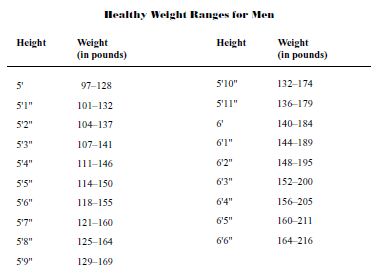
Check the following weight-for-height table to find out if your weight falls into the healthy range. Look up your height on the left side of the table, and move across the table to find your weight. If your weight is not in the healthy range for your height, you are more likely to develop weight-related health problems.

Weights above these ranges are less healthy for most people. The farther you are above the healthy weight range for your height, the higher your risk of weight-related health problems. A weight slightly below the range may be healthy for some people but sometimes results from health problems, especially when weight loss is unintentional.

Maintaining a Healthy Weight


Being overweight is a major health problem in the United States, and there are many good reasons to keep your weight within a healthy range. You will feel better, look better, and have more energy than men who are overweight. Having more energy makes you more likely to exercise, which can help you fall asleep faster and sleep more restfully. But the most important reason to keep your weight within a healthy range is that you will lower your risk for certain chronic diseases, including heart disease, high blood pressure, diabetes, and certain forms of cancer. Doctors no longer believe that it is acceptable to gain a few pounds as you age. Maintaining your weight at a reasonable level throughout your life is key when it comes to reducing your risk for disease. Many overweight men have difficulty reaching their healthy body weight, and the more you weigh above your ideal weight, the harder it can be to lose the extra pounds. It is encouraging to learn, then, that losing even a relatively small amount of weight can reduce your chances of developing heart disease or stroke. For example, reducing your weight by just 10 percent can improve the efficiency of your heart, lower your blood pressure, and reduce the level of cholesterol in your blood. In fact, you can increase your overall health by losing as few as 10 to 20 pounds. Slow and steady weight loss of no more than 2 pounds per week is the safest way to lose weight. Too rapid a weight loss can cause you to lose muscle mass rather than fat tissue and also can increase your chances of developing other health problems, such as gallstones, gout, and nutrient deficiencies. Making long-term improvements in your diet combined with exercising more is the best way to lose weight and keep it off. When trying to lose or maintain weight, look at your eating habits and try to improve them. Follow the eating guidelines recommended in the Food Guide Pyramid for the best dietary advice. Physical activity is also essential to weight control. Try to exercise for at least 30 minutes every day; start exercising slowly, and gradually increase the intensity of your workout.
If you are not currently overweight, but if weight problems appear to run in your family, you still need to watch your weight. Men who have close family members, such as grandparents, parents, and siblings, with weight-related health problems such as diabetes are more likely to develop similar health problems. If you are not sure of your risks of developing a weight-related health problem, talk to your doctor. Although most men with a weight problem are those who struggle to lose extra pounds, a small percentage of men are actually underweight for their height. Men tend to diet for different reasons than women to improve athletic performance, for example and some men develop eating disorders, such as anorexia or bulimia, from extreme dieting, although these conditions are much less common in men than in women. Keeping your weight within a healthy range over the years requires self-control and a commitment to your health. If you are already overweight, work with your doctor to develop a safe and effective weight loss plan that can help you keep your weight down over the long term. If you are underweight, your doctor can help you plan a diet that will allow you to gain weight sensibly.

Related Posts Plugin for WordPress, Blogger...
Twitter Delicious Facebook Digg Stumbleupon Favorites More